A Blue Micromoon Rises Sunday — the Smallest, Farthest Full Moon of 2026
The rare celestial event pairs a second full moon of the month with the moon's most distant point from Earth, plus a brilliant star for company
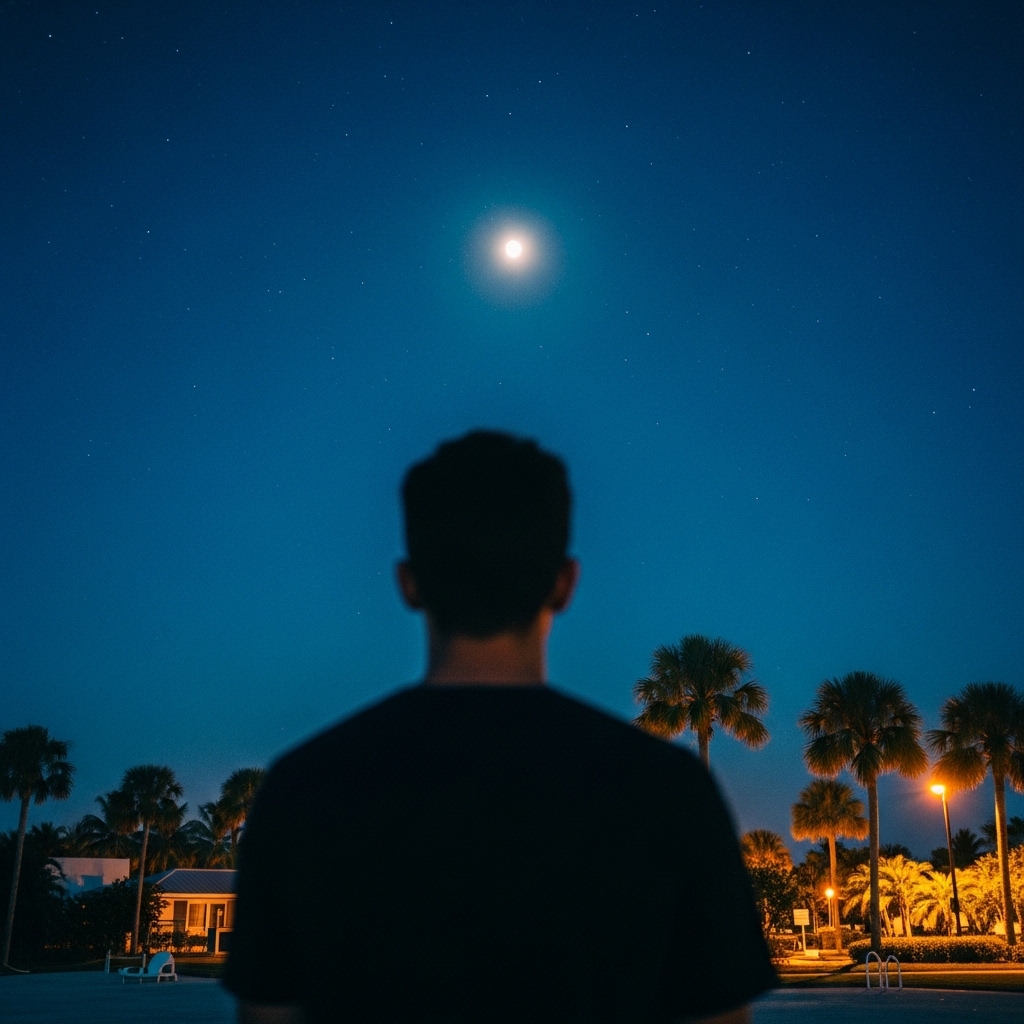
Step outside Sunday night and look up. The full moon hanging over the Indian River Lagoon will be something worth pausing for — even if it doesn't look it.
This weekend's full moon is a blue micromoon, a rare convergence of two celestial quirks that happens only once every few years. It is a blue moon — the second full moon in a single calendar month, with May's first having risen on May 1 — and it is also the most distant full moon of the year. At 252,360 miles from Earth, it sits at the far end of the moon's elliptical orbit, a point astronomers call apogee. That's nearly 27,000 miles farther away than the most recent supermoon, which closed to within 225,130 miles.
The distance makes it a micromoon: physically the same object, but appearing roughly six percent smaller and 10 percent dimmer than an average full moon. Gianluca Masi of the Virtual Telescope Project, who will broadcast the event live via webcast from Italy, called those differences "subtle enough to likely go unnoticed by most observers." The moon will not appear blue, despite the name. The term is purely a calendar curiosity, referring to that uncommon second-full-moon-in-a-month occurrence, which comes around every two to three years.
A third element is worth tracking Sunday night. The red supergiant star Antares — the "heart of the scorpion" in the constellation Scorpius, roughly 550 light-years from Earth — will burn visibly alongside the moon in the southern sky. Observers in South America, New Zealand and eastern Australia will witness something even rarer: the moon passing directly in front of Antares, briefly blotting it from view. Treasure Coast residents will not see that occultation, but the pairing of the swollen reddish star against the bright, distant moon will reward anyone patient enough to let their eyes adjust.
Treasure Coast skies this time of year benefit from low interference before the summer thunderstorm season fully sets in. Find a dark stretch of beach away from the glow of Stuart or Fort Pierce — the Hutchinson Island shoreline or the undeveloped reaches of Sebastian Inlet State Park offer cleaner horizons — and look southeast after moonrise for the full effect.
The next blue moon is not expected until 2028.
This article was generated with AI assistance using publicly available information. It was reviewed and approved by a human editor before publication. TC Sentinel uses AI writing tools in accordance with FTC guidelines.
Got a tip?
See something newsworthy? Help us cover the Treasure Coast.
Your identity is never published without your permission.

Comments
Be the first to comment.